

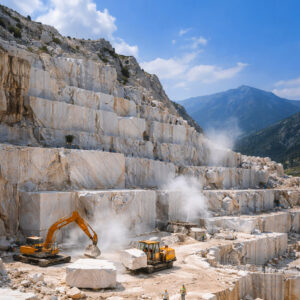
 Long before marble becomes sculpture, it begins its journey deep within the earth. Formed over millions of years through intense pressure and heat, marble originates as limestone that slowly transforms into a dense, crystalline stone. This geological process gives marble its strength, subtle translucency, and distinctive veining—qualities that have made it the preferred material of sculptors for centuries.
The quarrying of marble is both an industrial and highly precise operation. In regions such as Carrara—perhaps the most famous marble source in the world—entire mountainsides are carefully surveyed before any stone is removed. Quarrymen study the natural fissures and veining within the rock to determine where large, intact blocks can be extracted. Modern techniques now combine diamond wire saws, controlled drilling, and strategic cutting to separate massive blocks of marble from the mountain while minimizing fractures.
Once freed, these blocks—often weighing many tons—are transported from the quarry to processing facilities. Here, they are inspected, trimmed, and graded based on color, density, and structural integrity. Only select blocks are suitable for sculpture, as carving demands stone that is both strong and consistent throughout. Any internal weakness could compromise months or even years of work.
After selection, the marble is shipped to sculptors’ workshops around the world. Historically, these journeys were slow and dangerous; today they remain complex, requiring careful handling to protect the stone from damage. When a block finally arrives at the workshop, it is still far from becoming art. The sculptor studies the stone carefully, considering how its natural veining will interact with the intended form. In many cases, the figure is not imposed upon the marble, but discovered within it.
Carving from a single block is an act of irreversible commitment. Unlike cast materials, marble allows no corrections. Each strike of the chisel removes stone permanently, making the sculpting process one of patience, foresight, and restraint. The result is a work that carries both the history of the earth and the discipline of the human hand.
From mountain to workshop, marble’s journey is long, demanding, and deliberate—qualities that continue to define the enduring value of marble sculpture itself.